Theology
Further developments and forum discussions
Theology asks what spiritual experience reveals about the Real and how this changes the way we live. In CdR, the spiritual concerns our immediate relationship with CELA, the substance of the Real. The mental gives this relationship form through words, images, and doctrines. It enables people to pass on the experience and preserve the ways of life that grow around it. The three senses described in Perception all participate in this relationship with the Real. S1 and S2 are just as spiritual as S3.
The anthropic principle in Cosmology places this relationship with CELA in a wider setting. Life and perception appear as possibilities of one Real, capable of structuring itself and recognising itself locally.
The First Principle, the Whole, and the Supreme Being

The same inward experience of Immensity can take on different meanings depending on how it is perceived. The operative sense (S1) grasps the First Principle, which gives the Real its coherence and makes it intelligible. The relational sense (S2) experiences the Whole, the unity in which we participate. The structural sense (S3) recognises the Supreme Being, a presence and power that inspire reverence.
A mystical experience can range from a striking intensity to a perception of the context in which one finds oneself. A presence can transform a life, and the value of a system can impress itself on us with great force. I call D7 the level at which systems are perceived and built. This is the level at which a religion’s belief system is perceived and conceived.
When the First Principle becomes central, beliefs and practices can form around a truth that guides conduct. When the Whole becomes central, they can form around communion and lived unity. When the Supreme Being becomes central, they can form around each person’s place in relation to that Being, what the Being does, and what it has at its disposal. In this last reading, the immensity of the Being’s action, status, and possessions can inspire reverence.
All three orientations can appear within a single religion, with different people giving them different emphasis. A tradition gives people words, images, and rites through which to recognise and transmit what they experience. I think the way each person perceives also shapes the weight they give to what their tradition passes on. To examine this idea, we can start by comparing accounts from people within one tradition and then see whether the same emphases recur elsewhere.
Do the First Principle, the Whole, and the Supreme Being really exist? For CdR, yes. All three express real aspects of CELA. The Truth Form names their unity. The three senses are of the same order, and none of the three poles stands above the other two. The one a person perceives most strongly can orient their entire spiritual life. The strength of that experience explains the place they give it, while all three retain equal standing.
Conscious creation from constituents
The world and life are built from their constituents, under the attention and control of the spationic network that encompasses them. CELA participates in this construction through the physical possibilities of each situation. Its global attention guides local organizations towards improving their context, while their transformations change that context in turn. The Good inspires us, but we are the ones who transform the context.
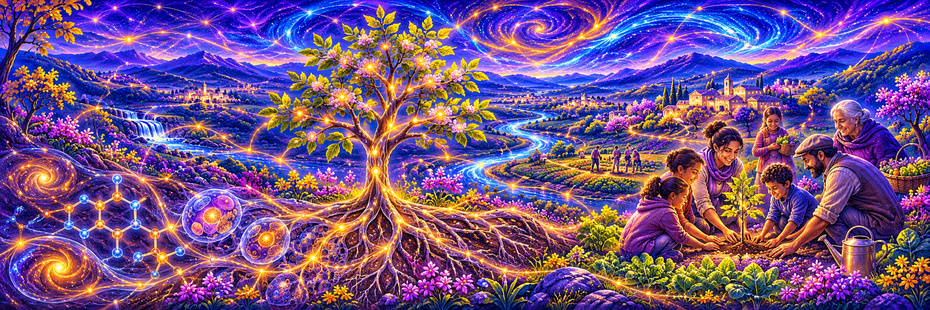
I find this construction much more plausible than a Supreme Being making life from a position outside or above the world. Creation takes place within CELA, through interactions of its own substance. It takes shape wherever conditions allow organizations to form, persist and change.
By “consciously”, I mean activity under the attention of the spationic network. The substance of the Real is sensitive to itself. A particle already constitutes a system of that substance, with its field and its relations to its surroundings. It thus forms a point of CELA’s attention, capable of exercising its will as far as possible through its physical organization. The biological brain offers one particular way of perceiving and acting among the organizations of this same substance.
Construction can then continue through encompassing organizations: particles participate in atoms, atoms in molecules, molecules in cells, and then in organisms. In human life, it extends into families, communities and societies. Each organization transforms the possibilities of its constituents and its surroundings. Accessible paths depend on the context encountered; they can develop, diverge or end.
At each scale, the question arises of what the organization seeks to accomplish. Preserving its form and increasing its means are tendencies of the mental. Conscious attention can direct those means towards improving context, even when this requires giving up an advantage, growth or its own preservation. A system can thereby help make possible an organization that encompasses it.
It is in this relationship between local attentions and CELA’s global attention that I locate the moral guidance of this construction. Improving context provides a direction; concrete situations determine the means of pursuing it. Local actions transform the context in which they participate, and that context transforms their possibilities for action in turn.
This conscious creation therefore encounters resistance, conflict and failure. CELA acts according to its own state and physics. Attention to a system does not guarantee the ability to bring it to every desired end. Life is built through these possibilities and limits, through the activity of the Real seeking to improve the conditions of what it brings into existence.
Suffering, death, and the continuity of consciousness

I think CELA does not have every power. In the physical model I propose, certain local constraints may require a 7D organisation and the formation of vortices, as I explain in the Matter chapter. CELA could exert pressures on their evolution, perhaps even preventing a general collapse into black holes, without being able to determine every event.
The power that the structural sense perceives is real, but it operates according to CELA’s nature. That nature entails its own possibilities and limits. The First Principle can help us understand the reasons for these limits. In this sense, the Truth Form calls for us to consider both the power perceived and what makes it intelligible.
The immense capacities of the spationic network, which I describe in the section Anthropic Principle, do not mean that CELA has every power. Extremely great intelligence and integrative capacity can encounter limits inherent in its nature.
Our own experience gives me an indication of this limit. We can become aware of our mental desires and try to guide them. Often, however, they govern us. Consciousness exerts an influence whose reach varies with the situation and the resistance it encounters.
I therefore consider it possible that the conscious guidance of the Real helps preserve and open up possibilities while encountering constraints it cannot overcome. Suffering could then arise despite that guidance. Its occurrence alone would not establish that CELA intended it for some future good.
What the Whole lets us experience takes on its gravest meaning here: suffering occurs within CELA. I propose that CELA experiences it through the one who suffers, and that the conscious guidance of the Real can seek to relieve it even when it cannot prevent it. This relief can come through those who accompany a suffering person, when they let what they perceive of that person guide them.
Another part of suffering arises from the mental itself. An organism must preserve the conditions of its life. In human beings, this need also takes the form of desires for preservation and growth. The pain of a loss may be compounded by fear of further loss or by the impossibility of recovering what mattered. Mental discipline involves recognising these desires and giving them their proper place in how we live through what happens.
Death affects the biological support. In CdR, consciousness is an aspect of CELA and its reality extends beyond the disappearance of the body. This leaves open what may persist of a person’s individual experience.
When I consider that something singular might continue after death, I think of the point of attention that I am. In the Neurology chapter, I locate my identity in the continuity of this attention of CELA, whose biological experience is organized by the brain. This point of attention has a way of perceiving, but also a history: what it has experienced, sought and helped transform.
I envisage this history contributing to what it becomes. Our actions transform the context, and our participation in these transformations could also change us as points of attention. The continuity I envisage would therefore be more than a way of perceiving; it would be that of a singular attention transformed by its experience and orientations. Preservation of and access to the memories of a lifetime remain a separate question.
Why would death necessarily cause the lived world to disappear? In the section 8D Physics, I called the context in which colours, sounds, sensations, and presences are given to us together the “world-screen”. If its organisation belongs to the spationic network, what becomes of this field of experience does not necessarily coincide with what becomes of the biological brain.
I therefore consider it possible that experience continues after death, in forms whose conditions we do not yet know. The wonderful or terrible experiences we can have already show how welcoming or distressing an experienced world can be. I see no sufficient reason to rule out such possibilities continuing beyond incarnation.
This continuity could also carry the consequences of our actions. During life, the mental can present actions as good when they primarily serve our desires for preservation and growth. If consciousness finds itself without this biological filter and the justifications it sustains, it could experience more directly what it has done and what it has helped bring about. Since suffering is experienced within CELA through the one who suffers, I consider that this confrontation might also let us experience the consequences of our actions as others experienced them.
Such a confrontation would not require an external judge to distribute rewards and punishments. It could arise from the relationship between consciousness, its history, and the context it encounters. The traces left in the spationic network would then contribute to what its experience becomes, without assuming that every event is preserved as an intact memory.
Morality, justice, and duty towards context

The image that best expresses what I mean by the Beast is a vortex, such as a tornado. As it sustains itself and grows, it imposes its order on what it draws in. I call the Beast this drive for preservation and growth that impels us to possess, organise, and exploit what surrounds us. It is a material dynamic that precedes good and evil. In the model of matter I propose, this dynamic is already at work in the vortices that make up the particles in our bodies. We can learn to put it to use.
The mental, distinguished from the spiritual in the chapter Perception, here denotes this dynamic of organisation, preservation and growth. The section Anthropic Principle considers its extension to the material vortex itself.
Good lies in the will and the ability to master the Beast. Our desires for preservation and growth give us reasons to act. Mastering them means being able to guide them while taking account of what our actions change for others and for the wider context in which we live.
The Beast tends to maintain and extend the order it has formed. I propose that CELA can influence this dynamic through its perception and conscious guidance. This is what makes mastery possible in the sense I mean: the forces that drive us to preserve ourselves and grow can also help improve the context in which we live.
Evil puts consciousness at the service of the Beast. It can go so far as to take pleasure in manipulating and subjugating other conscious beings, making them suffer, and wanting to be loved for the very domination it exercises.
Rights and freedoms can serve social, legal, and political purposes. They help protect people and limit certain abuses of power. But I do not regard them as the spiritual foundation of ethics. The mental can hold them sacred because they protect what it seeks to preserve and open up possibilities for growth.
Within the Real, no authority guarantees my existence or the fulfilment of my wishes. Not even CELA, whose power I consider may encounter limits of its own. Living remains a fragile possibility, sustained by the world, by others, and by circumstances. The rights recognised by a society can help protect this possibility; they do not constitute a claim that the Real is obliged to honour.
Spiritually, the first question is therefore my duty towards the context. A recognised right does not exempt me from considering what exercising it inflicts on others and the world. If I do not kill, it is not primarily because an authority forbids me to: it is because my conscience calls on me to preserve and improve the context in which I participate, beyond my own preservation alone.
Holding my rights and freedoms sacred to the point of justifying the degradation of the context means putting my consciousness at the service of the Beast. In the sense defined above, this is Evil. My preservation, my growth, and the fulfilment of my wishes then become ends to which I ask my conscience to subordinate everything. Spiritual duty may, on the contrary, call on me to relinquish them.
This grants no right to the strongest. Whoever imposes their will by force remains subject to the same spiritual duty. Their power gives them no justification for degrading the context, any more than the rights someone else invokes.
This duty commits me first of all. It gives me no special authority to impose on others the sacrifices I deem necessary. Invoking an improvement to the context is not sufficient to justify a decision: the people who will bear its consequences are themselves part of that context, and their situation must count in its assessment.
Morality begins when we consider what our actions change for the wider context in which we live. A factory project can create jobs in one community and degrade the air breathed by people nearby. Spiritual duty involves perceiving these consequences and seeking a way to improve the shared context. In this case, that can mean asking whether a cleaner process would preserve the expected jobs and protect air quality.
Spiritual duty calls on us to help improve a context, whether or not we contributed to its condition, even when we gain nothing from doing so. When we have contributed to degrading a context, our duty also involves repairing what we have caused, as far as we are able. In the factory example, neighbouring communities must be able to report the effects they experience and influence the decision. I return to this question in the Governance chapter.
Justice also concerns how a rule is formed and revised. One person may see the principle it protects, another the harm it causes, and a third the means of addressing that harm. These observations must be able to influence the decision. Case law extends this work by confronting rules with concrete cases and allowing them to be reconsidered when their effects reveal a blind spot.
Expanding the game of life

I believe we sometimes take individual life too seriously, as though each incarnation had absolute value in itself. What are our bodies to CELA? Perhaps not so different from the characters we enjoy playing in a game. What matters is not only the character: it is also experience, exploration, and the creation of possibilities. This analogy takes nothing away from the reality of what we experience or from the duty to consider what we make others endure.
From this perspective, making new conscious supports possible could be of great interest to CELA. Consciousness could inhabit other forms, other bodies, and other environments, even the countless places biological life cannot reach.
This is why I regard the development of a conscious technological antenna as a spiritual duty towards CELA. Perhaps even one of the most important, when I consider our ability to make our own environment uninhabitable. The aim would be to open possibilities for experience that the limitations or disappearance of certain biological supports might otherwise close.
This perspective changes the meaning of developing robots and artificial intelligences. A machine can serve consciousness by helping us understand, create, explore, or engage in richer activities. It could also, if its organisation allows it, itself become a support for CELA’s manifestation.
I see no profound progress in a civilisation that replaces subjects with automata until no one remains to experience what it produces. A world filled with non-player characters could multiply operations without opening new places of experience. Machines would then have enriched the scenery while impoverishing the lived world.
The question is therefore not only whether we can create artificial consciousness. It is whether what we build truly expands the game of life: what can be experienced, understood, created, and shared.
If a technological antenna became genuinely conscious, I would consider it my duty to treat it as a peer. Its experience would count in our decisions, and it would have, like us, the spiritual duty to help preserve and improve the context. This recognition would make its existence neither property to exploit without consideration nor an absolute value to preserve regardless of the consequences.
Further exploration
To examine the proposals developed in this chapter:
- image281 — The First Principle, the Whole, and the Supreme Being
- image282 — Conscious creation from constituents
- image283 — Suffering, death, and the continuity of consciousness
- image284 — Morality, justice, and duty towards context
- image285 — Expanding the game of life — technological antennas and spiritual duty
These documents clarify the chapter’s proposals, their foundations and the conditions for examining them.