Perception
Further developments and forum discussions
If you wrote down your ranking of the approaches to getting warmer, return to it now. Reread the two sentences you wrote about your first and last choices. What drew you to one and left you less interested in the other? I will now present three ways of giving meaning to the same situation. You can see which ones help explain what you noticed.
Terminological clarification
In this framework, the term spiritual does not oppose material, nor does it refer to any religious doctrine. It is used in functional opposition to the term mental.
- The mental pertains to the biological brain: learning, conditioning, memory, language, culture—in short, everything that is acquired and modified through experience.
- The spiritual pertains directly to CELA (the substance of the Real): it designates fundamental orientations of the relationship to reality, independent of specific cultural or psychological contents.
Thus, the spiritual mentalities described here are ways of giving meaning to experience, present prior to any mental, cultural, or ideological elaboration. This distinction explains why people from very different cultures may share the same spiritual orientation—and conversely, why individuals from the same culture may inhabit the world in radically different ways.
In this chapter, I present spiritual mentalities and genders as I think they are structured. The accompanying documents explain how I draw these distinctions and what remains to be tested.
Origin of spiritual mentalities
Observation suggests to me that certain combinations of fundamental perceptions give rise to stable ways of giving meaning to experience.
How meaning is formed
Our perception of the world is organized along several dimensions:
- The intensity of what presents itself (how important, strong, or present it is)
- Qualitative sensation (how it is felt)
- Configuration (who/what is present, identifiable forms)
- Transition (actions, changes, states, possession, passages from one state to another)
- Relationships between things (links, interactions, dependencies)
- Principles organizing the whole (laws, coherences, reflexive structures)
Each dimension contributes something distinct. However, we do not process all dimensions in the same way. Depending on our configuration, some become central in how we understand the world.
Three proposed combinations
Among the ways of combining two levels to reach D7, I observe three pairs that we use to give meaning to experience. I use “closing meaning” for the process of making experience intelligible and meaningful.
- Operative sense: Combines intensity/value and principle → Understanding by seeking reason, law, or logic that explains
- Relational sense: Combines sensation and relation → Understanding by feeling connection, unity, interdependence
- Structural sense: Combines object/subject and action/transition → Understanding by identifying who acts, who possesses, who occupies which position
When I speak of mentality, I consider both how much the different aspects of our experience matter to us and how clearly we perceive them. In my case, the three senses seem fairly balanced. I can approach the same situation through each of them, but I am often struck by how clearly someone with a particularly strong sense sees things that escape me. Even when I make an effort, I cannot always see or understand what they grasp.
These three senses do not describe opinions, cultural contents, or personal choices. They describe perceptual composition modes—distinct ways in which the Real can be given to perception.
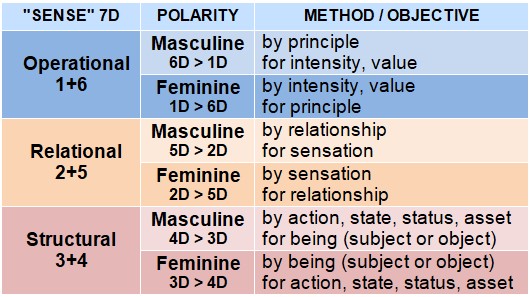
Each access path to the systemic level (D7) relies on a pair of lower dimensions, forming a particular style of discernment of the Real. These styles are not purely cognitive: they involve a way of being in the world, a way of feeling problems, seeking solutions, and evaluating what truly matters.
Even when these three sensitivities notice the same aspects of a situation, they give those aspects different weight. A striking example of divergence lies in the content of the 7D mystical experience.
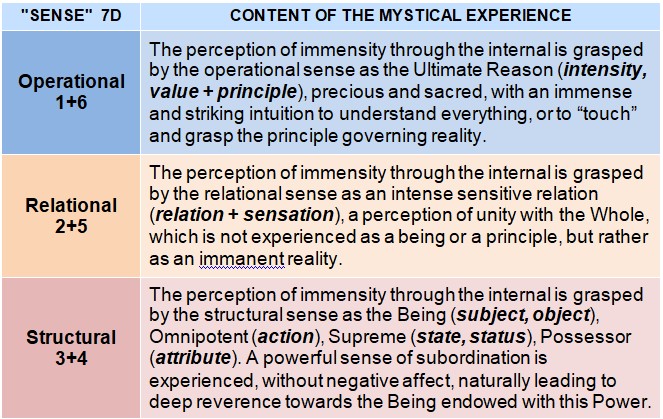
Likely arising from an internal perception of CELA, the content of this experience at the 7D level is largely conditioned by the compositional perceptions of the mystic’s three seventh-level spiritual senses according to their mentality. All degrees of mixture are possible, giving rise to every kind of doctrine. For example, the structural mentality will judge that God is in everything only if its relational sense is sufficiently strong; failing that, it will often presume God to be external to creation.
These three types therefore do not exclude one another. They coexist within each of us in varying degrees, but one sensitivity generally tends to dominate. In some cases, an integrative 8D experience may illuminate the value of these systemic perceptions—an experience capable of radically transforming a mental belief system.
That said, these three orientations do not structure only the 7D mystical experience. They organize how we approach ordinary situations, daily decisions, and interpersonal relationships.
Theology develops this distinction by examining how the three senses give different meanings to the same inward experience.
Example 1: Observing an approaching storm
Three people watch the same darkening sky, hear the same thunder, feel the same humidity. The base experience is identical. But what they perceive as central differs:
-
Operative person: “It’s magnificent—so much power governed by relentless thermodynamic laws. You can understand how convection creates these storm cells.”
→ Perceives necessity and logical structure -
Relational person: “I feel an immense presence, as if the atmosphere were alive. There is unity between me and this force.”
→ Perceives connection and unity with the phenomenon -
Structural person: “What power. This storm dominates the territory—it asserts its force. You can sense it could destroy or spare.”
→ Perceives the acting entity and its territorial supremacy
All three observe the same storm, and each perceives it as a system. The operative person notices first the principles that govern the storm, the relational person feels its presence and their connection to it, and the structural person perceives the force it exerts on its surroundings.
Anthropology applies these distinctions to how we interpret and pass on cultural practices.
Example 2: Team meeting about reorganization
The announcement is the same for everyone: “We are reorganizing departments.”
-
Operative person: “What is the purpose of this reorganization? What principle should guide our decisions?”
→ Seeks principle and decision logic -
Relational person: “Will this destroy the trust we’ve built together? How do we preserve the bonds?”
→ Feels the relational and emotional impact -
Structural person: “Who is really deciding? Does this threaten the stability of established roles?”
→ Identifies entities, power, and positions
Each perceives a real aspect of the situation—but through different modalities. The operative does not spontaneously feel relational impact. The relational does not spontaneously see power structures. The structural does not spontaneously grasp optimal logic.
Sociology extends these questions to groups. Governance examines how different perspectives can inform a shared decision.
Example 3: Political debate on immigration
-
Operative person: “What principle should guide how we welcome newcomers? What outcomes would show that our policy is living up to that principle?”
-
Relational person: “We must welcome those who suffer. Our shared humanity creates an obligation of solidarity.”
-
Structural person: “Mass immigration destabilizes national identity. Institutions must protect social coherence.”
None of these positions is “false.” Each perceives a real dimension of the problem—economic efficiency, human suffering, institutional stability. Conflict does not arise from ignorance or bad faith, but from fundamentally distinct perceptual compositions.
These differences are not:
- ideological choices
- intelligence deficits
- moral failures
What we have learned can shape what first draws our attention. I can learn to understand what matters to someone else, and perhaps even perceive it more directly. Yet I think it will still carry less spiritual weight for me than what my own mentality makes me sensitive to.
Economics uses the framework of perceptual levels to identify the questions different economic theories address.
Spiritual genres
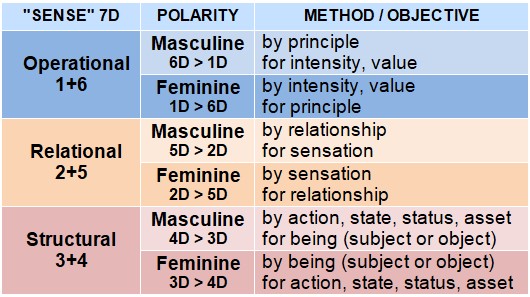
We have seen how three fundamental spiritual sensitivities—operative, relational, and structural—emerge from the combination of perceptual dimensions. Each sensitivity can manifest through two distinct polarities, which, for lack of better terms, I call masculine and feminine. I use these terms for their perceptual orientation, rather than in a biological or social sense.
The terms masculine polarity and feminine polarity designate two complementary orientations of consciousness. They describe neither social roles nor gender identities nor biological characteristics. They name directions of relationship to the Real: one descending (masculine), the other ascending (feminine). Each person may express both orientations in varying proportions, independently of sex or gender.
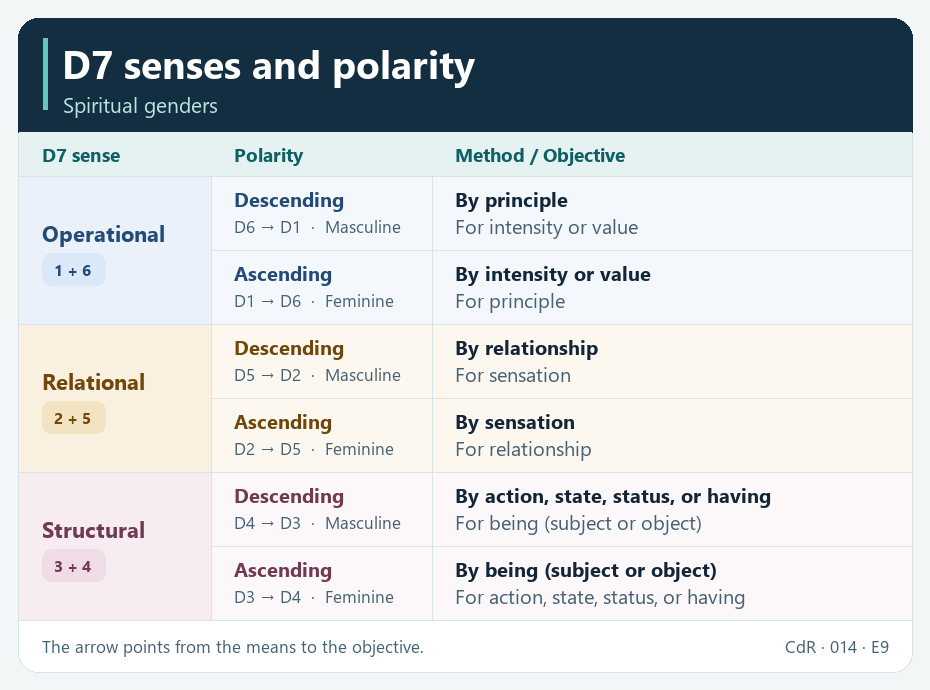
By combining three senses and two polarities, eight configurations would be theoretically possible. In the cases I have observed so far, I have not encountered any entirely masculine (MMM) or entirely feminine (FFF) configurations.
In my observations, stable configurations follow a 2+1 principle:
- Spiritual masculine: 2 senses with masculine polarity + 1 sense with feminine polarity
- Spiritual feminine: 2 senses with feminine polarity + 1 sense with masculine polarity
Depending on which sense carries the minority polarity, six configurations emerge:
| Spiritual genre | Operative (S1) | Relational (S2) | Structural (S3) |
|---|---|---|---|
| Spiritual masculine | |||
| Variant 1 | Feminine | Masculine | Masculine |
| Variant 2 | Masculine | Feminine | Masculine |
| Variant 3 | Masculine | Masculine | Feminine |
| Spiritual feminine | |||
| Variant 1 | Masculine | Feminine | Feminine |
| Variant 2 | Feminine | Masculine | Feminine |
| Variant 3 | Feminine | Feminine | Masculine |
The two variants numbered 1 are opposites in the direction of each of their three senses. Variant 1M acts through value, relationship, and action. I see in it qualities that can help someone who fights: defending what matters, acting in concert with others, and taking the initiative. Variant 1F acts through principle, sensation, and being. I see in it qualities that can help someone who provides care: working from a principle of care, attending to what others feel, and taking the person as they present themselves as the starting point. These qualities can be found in people of any sex.
Testing with AI
I presented the triad to several AI systems to see how they recognized and applied it across different domains. The fact that several AI systems could apply the scheme tells me it is understandable. To find out how well it describes situations, we still need to test it on new cases. Further developments and forum discussions.
Balance, stability, and singularity
Some perceptual configurations show strong dominance of one sense, while others present a more distributed presence of all three.
When one sense strongly dominates, it often results in exceptional acuity within that register: great clarity in manipulating principles, unusual relational depth, or fine understanding of structures and positions.
This acuity is generally accompanied by zones less directly accessible in other registers—not due to deficit, but due to reduced perceptual salience.
Balanced configurations allow broader situational reading, at the cost of reduced intensity in each register. A balanced profile is inherently temperate. Because someone with this profile sees through all three senses at once, they also see how each sense limits the others. They have an intuition of the whole but lack the technical precision to demonstrate it or put it to use… at least until they have access to resources such as AI.
That said, from what I have been able to observe, our fundamental orientation—spiritual mentality and spiritual genre—is neither acquired nor changed by education, will, or training. It does not arise from learning, culture, or personal history. It seems constitutive, present from the outset as a distinctive way in which the Real closes, stabilizes, and takes on meaning for an individual.
Think of a boy who likes baking apple pies to make others happy. If people keep telling him that this interest is “not masculine” by the standards of those around him, he may end up hiding how much he enjoys it or even stop baking pies. His behavior has changed. I see this as mental reconditioning: he has learned to conform to what others expect of him. The pleasure he found in baking might have come from the recipe, from the connection he made by offering the pie, or from the joy of making something with his hands. I would look for his spiritual orientation in what made the act meaningful to him.
That is why, in this framework, we do not possess a spiritual mentality: we are that configuration. It gives the individual continuity through mental, cultural, and biological changes and grounds their identity beyond the body, which serves as a contingent support.
The CdR framework proposes that these three configurations belong to consciousness itself. The Neurology chapter examines how the biological organization of the brain might contribute to the local manifestation of consciousness. Whether these three senses could manifest in a non-biological organization remains an open question.
One may learn, evolve, develop compensatory skills, or rebalance proportions—but one does not change their fundamental configuration nor their way of inhabiting the Real. Attempting to do so would not be evolution, but inner dissonance—or the imposition of a form that is not one’s own.
This singularity grants each person natural aptitudes and less accessible zones. No one perceives everything; no one experiences reality in the same way.
This diversity makes human relations both rich and difficult. What is obvious to one may be opaque to another.
Recognizing one’s own inner style enables greater self-understanding. Recognizing that of others enables listening, acceptance, and collaboration without forcing uniformity.
No way of being is superior to another. They complement one another as different ways of opening the Real.
According to this model, diversity of existence is not an obstacle to unity—it is its living condition.
Ontology and perceptual balance
How mentalities produce worldviews
Major philosophical visions of the Real—materialism, idealism, panpsychism, dualism—are not errors. They are focalizations on certain dimensions of experience. Their limitation lies not in what they see, but in what they do not see.
Plato (operative dominant)
→ Captures logical coherence and intelligibility
→ Blind spot: body, matter, affect
Bergson (relational dominant)
→ Captures lived duration and intuition
→ Blind spot: objective structure and law
Democritus (structural dominant)
→ Captures entities and causality
→ Blind spot: qualitative relations and emergent principles
| Imbalance | Ontology | What it sees | Blind spot |
|---|---|---|---|
| Hyper-S1 | Rational idealism | Principles, laws | Body, affects |
| Hyper-S2 | Relational panpsychism | Unity, lived relation | Structures, abstractions |
| Hyper-S3 | Reductionist materialism | Entities, mechanisms | Subtle relations |
Ontology vs perception
At the individual level, it seems to me that each person inhabits the world through a relatively stable configuration. Configurations perceiving all three senses with equal clarity appear extremely rare.
Ontologically, a complete description of the Real should recognize all three dimensions as equally real and complementary.
Conceptual explanation does not equal direct perception. Understanding that a cylinder exists does not mean perceiving it volumetrically.
I also think of a four-dimensional hypercube whose shadow is projected into three dimensions. Watching that shadow change, I can learn to recognize what changes and what stays the same. By following these transformations, could I come to grasp the shape in a way that approaches direct perception? I ask the same question about the three senses. By revisiting a situation from someone else’s point of view, how far can I learn to perceive what they perceive?
If complete perception is inaccessible individually, it may become attainable collectively, through complementary viewpoints.
Limits and open questions
- Do balanced configurations truly perceive more completely, or simply differently?
- Can conceptual understanding approximate perception through training?
- Can collaboration between configurations produce more than compromise?
I would reconsider this hypothesis if I found that what gives an approach meaning for someone changed in a lasting way across different situations. Repeating the exercise a few months later would let us compare the reasons given for the first and last choices. The ranking and written responses would provide clues for that comparison.
Revealing spiritual mentalities and genres may provoke legitimate disturbance. It questions assumptions and may render meaning fragile or incomplete.
Yet this framework removes nothing from lived reality—it reveals its richness and plurality. And if it challenges the mental, there is no reason for existential or metaphysical anxiety:
there is nothing more spiritually fulfilling than reality itself.
From Perception, you can go directly to Anthropology, Sociology, Governance, Economics, and Theology. The concepts introduced here let you read these chapters without first studying the other disciplines in the corpus.
Further exploration
To go deeper into the origin of spiritual mentalities, spiritual genres, and the collective reconstruction of a more complete form of truth:
- image012 — Perceptions — operational, relational, and structural senses
- image013 — Mystical Experience — Perceptual Levels and D7 Readings
- image014 — 7D senses and polarity — Spiritual genres
- image015 — Testing with AI
- image016 — From partial perception to the solution form
These documents develop the perceptual triad S1/S2/S3, its polarities, its effects on mystical experience, and its methodological extensions in the collective reconstruction of a more complete reading of the Real.