Fundamental Structure
Further developments and forum discussions
In Consciousness of the Real, we have seen that the entirety of reality could be the product of a single substance: CELA, dynamic and self-complexifying. By unfolding along various dimensional axes, this substance could generate spaces and the organizations from which fundamental physical notions arise. The aim here is to propose how a single reality, exploiting different degrees of freedom, could generate the diversity of the world.
In other words, new physical notions could emerge from interactions between these dimensional organizations. Here is another way to represent them. It will soon allow us to approach particles as dynamic and relational configurations of CELA in multidimensional spaces.
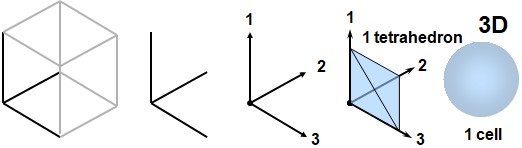
Starting from a simple three-dimensional cube, one selects three of its edges meeting at a point of origin: these are our first three dimensional axes, denoted here 1, 2, and 3. To represent a volume of CELA associated with these directions, one connects the origin to three points on the axes and closes the resulting tetrahedron. It serves here as a representation of a volumetric cell.
Counted according to the combinations of its three axes, this cell comprises:
- 3 axes (1, 2, 3) — directions of the substance’s unfolding;
- 3 surfaces associated with pairs of axes: 1-2, 1-3, and 2-3;
- 1 volume associated with the triplet: 1-2-3.
This count concerns combinations of axes. The drawn tetrahedron has four triangular faces; the face opposite the origin closes the volume without adding another axis combination to this list.
This basic cell will serve as a unit to understand:
- internal relations between the components of a physical system,
- interactions with neighboring cells,
- the genesis of notions such as force, energy, or particle structure.
By adding a fourth dimensional axis (axis 4) to the first three, the substance CELA is allowed to occupy a new direction of expansion, opening the possibility for the coexistence of multiple volumes within the same hyperspace.
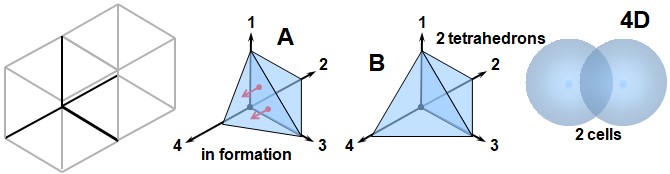
In illustration A, two volumes are represented by tetrahedra — the first based on axes 1-2-3, and the second, still forming, on axes 1-3-4. They share a surface interface associated with the pair 1-3. The red arrows indicate a redistribution of substance through this common interface.
Once formation is complete (illustration B), the two cells are linked through this shared surface. In the proposed intuition, an internal variation of density or pressure in one could then set the other in motion. This coupling between volumes would provide an origin for what we call a force in our physical world.
Thus, force would arise from the coupling between volumes made possible by this fourth axis. Sharing an interface opens this possibility; how motion is transmitted still requires a dynamics.
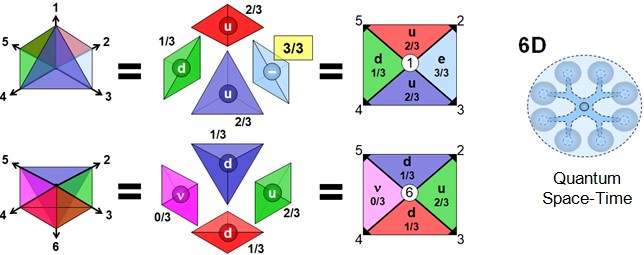
With the addition of two further axes (axes 5 and 6), the represented structure becomes more complex. The diagram retains eight tetrahedral volumes and allows us to count the axes each shares with the reference triplet 1-2-3: zero, one, two, or three.
The ratios — 0/3, 1/3, 2/3, 3/3 — correspond to the absolute values of the electric charges of the neutrino, down quark, up quark, and electron:
- 0/3 ⇒ neutrino: zero charge;
- 1/3 ⇒ down quark (d): charge −1/3;
- 2/3 ⇒ up quark (u): charge +2/3;
- 3/3 ⇒ electron (e⁻): charge −1.
Charges are expressed here in units of the positive elementary charge. Overlap indicates their magnitude without determining their sign. What determines the sign will be addressed later in the corpus.
In this representation, the six directions are grouped into three pairs opposed in the drawing: 1–6, 2–4, and 3–5. Taking one direction from each pair yields the eight triplets shown. Their overlaps with 1-2-3 are distributed into 1, 3, 3, and 1 configurations, from zero to complete overlap. This selection makes the overlaps visible, but its distribution is not that of the full framework.
These correspondences suggest that charges could be related to overlap between organizations of CELA. To become a physical explanation, this reading must also recover conservation of signed charge in transformations of matter.
This suggests that:
- Elementary particles would be dynamic configurations of CELA whose internal organization would not reduce to a classical point. This hypothesis must nevertheless recover their apparently point-like behavior in scattering experiments.
- The quantum of volume/matter would not simply be a “packet of energy,” but a cell of reality, simultaneously field and form, localization and dynamic structure.
- Quantum behaviors — indeterminacy, superposition, entanglement — could be related to configurations of these cells within a common multidimensional structure.
In other words, the physical world and spacetime itself would be made of CELA, contracted and combined according to precise geometric organizations. We — and the space in which we evolve — would consist of these configurations of a single substance. In this hypothesis, the cells would provide the support for spacetime, while their dynamic organizations would offer an approach to matter and its properties.
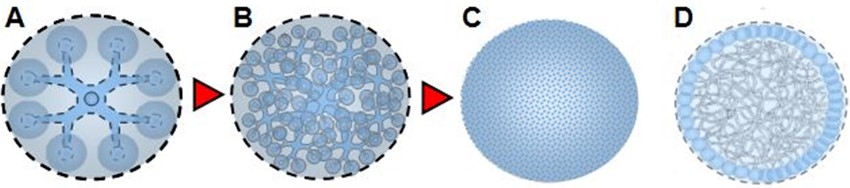
The progression A → B → C represents one organization repeating in a multitude of cells. In the CdR intuition, axes would combine extension and succession; CELA’s continuity would allow this local organization to extend and renew itself rather than remain a single realization. A finite number of configuration types could thus have a quasi-infinity of occurrences. The eight-volume representation makes this architecture visible, while the full framework retains its twenty internal triplets. This repetition is a hypothesis about the unfolding of substance, whose generative dynamics remains to be specified.
It would be mistaken to imagine these cells as neatly arranged beads or Lego bricks. In the proposed representation, they are dynamic, interconnected, fluctuating forms of a single medium. There is no absolute void between them, nor rigid boundaries that would make them independent objects.
Figure A — showing eight ordered cells — must therefore not be read as an assembly of beads. Views B and C suggest a dense, undulatory, foamy network. Its cells are envisaged as local manifestations of a more global organization, whose interfaces and couplings require specification beyond this three-dimensional representation.
Figure D attempts to sketch this idea: a kind of quantum foam without void, where the states of distant cells could belong to a joint configuration irreducible to separate states. CdR seeks in this unity of the medium a possible origin for entanglement correlations. Recovering these correlations nevertheless requires more than common membership: their statistics must be reproduced without allowing a signal to be transmitted faster than light.
In other words, the world we perceive as made of separate particles and empty space would in reality be a vast wave, composed of coordinated fluctuations of a single conscious substance—an embodied wave within the very structure of CELA.
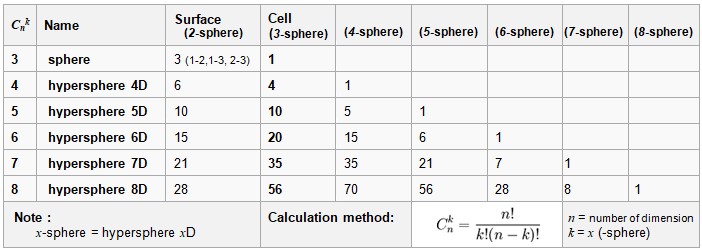
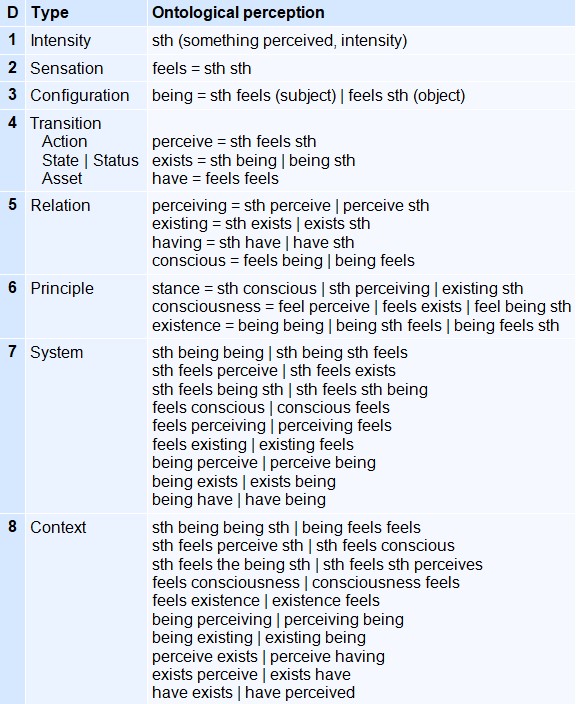
As the table above shows, six axes allow twenty distinct combinations of three axes. This number counts axis triplets; it does not constitute a geometric partition of a smooth hypersphere. In the CdR reading, these triplets define the twenty available internal volumetric configurations.
Within the full set of twenty triplets, overlaps with 1-2-3 are distributed into 1, 9, 9, and 1 configurations. Each of the twelve additional triplets contains both labels from one of the pairs opposed in the drawing. It is this full distribution that the remainder of the corpus retains: one neutrino configuration, nine Down configurations, nine Up configurations, and one electron configuration.
We will continue to use the eight-volume representation to make certain relationships visible. It rests on a precise selection from the twenty triplets: one label per pair. Opposed directions in the drawing do not demonstrate a physical opposition between the six internal axes. This simplified representation serves to visualize overlaps, without assigning physical configuration multiplicities to its count. How the nine configurations of each quark class relate to colors and generations, together with their dynamics, will be examined later; this account remains to be fully established.
Further exploration
The illustrations on this page are based on the detailed technical documents of the Fundamental Structure series:
- image006 — Axis Groups and Transfer — A Combinatorial Model
- image018 — Visual convention 1D → 2D → 3D — axis, plane, tetrahedron, cell
- image019 — Extension of structure toward a multi-volumetric framework
- image020 — 6D structure — Closed prototype, relaxation, and numerical diagnostic
- image021 — From the local pattern to a 6D network — repeated organization and generation hypothesis
- image022 — Internal 6D geometry — combinatorial blocks and graph structure
These documents detail the axial and combinatorial construction of the physical framework: proto-forms, visual conventions, multi-volumetric extension, the 6D prototype, network generation, and internal geometry.