Spacetime
Further developments and forum discussions
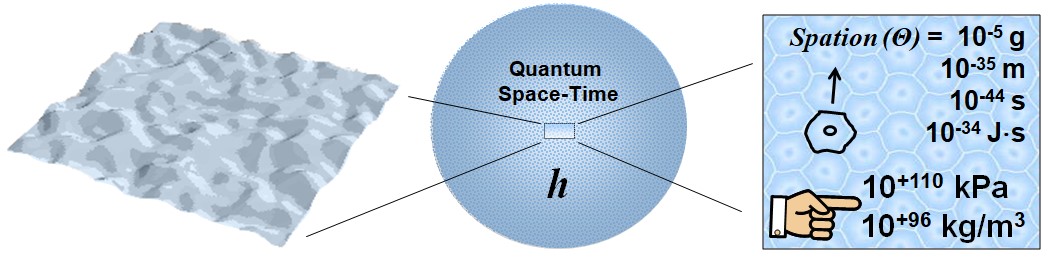
The six-dimensional hyper-volume (6D), introduced in the previous chapter, would correspond here to a cosmic domain: what we call spacetime would arise from its organization. CdR proposes that spacetime, continuous at our scale, originates in a cellular structure. These 3D cells — spations — would be the elementary organizations of the medium.
The spation represents the smallest unit of extent meaningful to our three dimensions of space. If the Planck length corresponds to this limit, it then gives the size of the spation, approximately 1.6 × 10⁻³⁵ meter.
The other Planck quantities form a coherent set with this length. The hypothesis is therefore that they also apply to the spation: a characteristic time of approximately 5.4 × 10⁻⁴⁴ second, an energy of approximately 2 × 10⁹ joules, a mass density of 5.2 × 10⁹⁶ kg/, and a pressure of 4.6 × 10¹¹³ pascals. The connection with the Planck scale thus follows from the elementary character attributed to the spation.
But before addressing matter itself, it is essential to explore certain properties of spacetime, or at least some functional ways of representing it, to better understand how matter, energy, and the fundamental forces might emerge from it.
Dynamic viscosity of spacetime
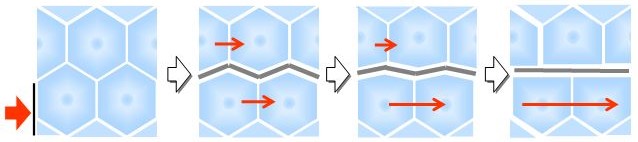
Spations would not form a rigid assembly. As the illustration shows, layers could slide over one another and reorganize during motion. Their interactions would resist this sliding while also drawing neighboring cells along.
This resistance would not be constant. As sliding increases, spations could rearrange more easily and offer less resistance to the layers’ relative motion. The medium would thus become more fluid under loading: this is what shear-thinning describes.
Such a medium could transmit pushes, propagate deformations and support waves. Its response would depend both on how spations are organized and on the time needed for their reorganization. Spacetime would then participate in the motions occurring within it, rather than merely providing their setting.
This idea also offers an avenue toward understanding inertia. In CdR, matter is an organization of the medium itself, whose spations can be renewed, rather than a foreign body passing through it. Accelerating it would require reorganizing the motions of participating spations. The hypothesis is that their response contributes to resistance to a change in motion while allowing uniform motion without drag.
Sub-spatial interactions
We can picture spations as balloons of different dimensional “colors”: 1-2-3, 1-2-4, and so on. But these colors should not be imagined mixed together in one box. Instead, imagine twenty boxes, each filled with balloons of a single color.
Inside each box, we cannot see that every balloon is a 3D face of a 6D structure comprising twenty spations of different colors. From the 3D viewpoint, it appears as one balloon among others, with no visible attachment to its neighbors. Balloons in the same box can therefore move relative to one another and mix completely, while remaining dimensionally linked to the other faces of their 6D structure.
Compressing one balloon makes nineteen others expand, distributed among the other boxes. As they expand, they compress their neighbors, which in turn make balloons of the first color expand. These may be very far from the initial balloon: dimensional links do not follow the distances we perceive.
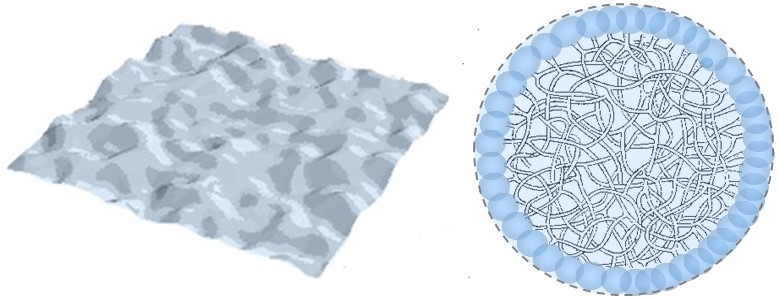
This jostling thus reverberates throughout the substrate and produces the fluctuations shown in the left-hand image. The medium forms a network of interconnections of astronomical extent and extreme complexity, which the right-hand image seeks to illustrate.
Inflareaction
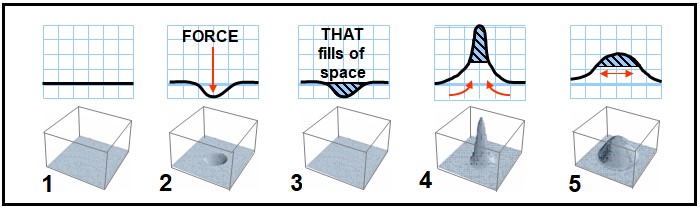
When a force jostles spations, it compresses them: this is the dip shown at stage 2. As the force is released, the spations relax and seek to regain their place.
But each spation remains linked to the nineteen other faces of its 6D structure. While it relaxes, the others remain under pressure from their own neighbors. This pressure acts through dimensional links and fills the first spation’s relaxed state: this is stage 3.
The spation therefore does not simply return to its starting state. Refilling temporarily creates excess density and pressure, represented by the bump at stage 4. This is what I call inflareaction.
This surplus in turn pushes neighboring spations and spreads through the medium. The bump broadens and subsides: this is the spreading illustrated at stage 5. An isolated jostle thus produces a passing effect.
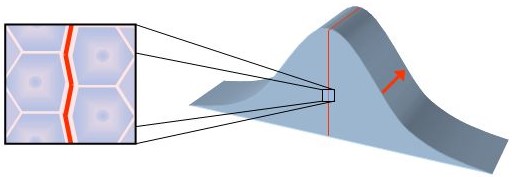
At the red interface, the two spation layers jostle as they slide against each other. Each new jostle triggers compression, relaxation and refilling again. The surplus is renewed while it spreads: the overpressure shown on the right can thus persist as long as the layers keep jostling. When sliding stops, jostling no longer renews the surplus, which continues spreading through the medium.
Further exploration
These fiches detail the proposed mechanisms, arguments and checks associated with the chapter’s illustrations:
- image023 — Theta granularity — spation, characteristic scales, and the quantum regime
- image025 — Dynamic viscosity of the spation — rheological hypothesis and B2 prototype response
- image027 — Quantum Entanglement — Network Coherence in the Medium
- image028 — Inflareaction — compression, relaxation, subspatial refilling and overpressure spreading
- image029 — Sliding and overpressure in — inflareaction hypothesis and driven prototype
These documents clarify the chapter’s proposals, their foundations and the conditions for examining them.