Matter
Further developments and forum discussions
Thresholds and transions
If spacetime unfolds within a six-axis organization, that organization could have a limit of resistance to compression. Beyond it, a spation could no longer retain its usual organization: it would reorganize using axis 7.
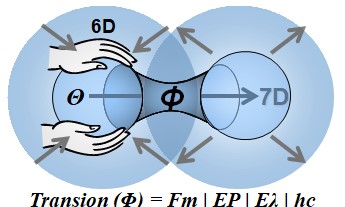
The hands depict compression of the spation in domain A. If pressure becomes too high, its structure would change rather than allowing further compression. Some of its configurations would then use axis 7 in place of an axis of the initial domain. The spation would not be projected elsewhere: its dimensional links would be reorganized. It would thus leave ordinary spacetime organization in part or in full for that of domain B, shown on the right. This passage is what the corpus calls a transion.
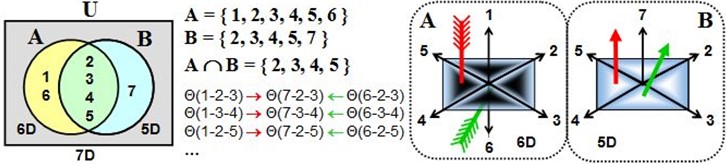
The image shows how some axes can be replaced while others are retained. In the left-hand drawing, A has axes 1 to 6, and B has axes 2, 3, 4, 5 and 7. Axes 2, 3, 4 and 5 are therefore shared by both sets. On the right, arrows make this reorganization more visible.
A type 1-2-3 cell could thus become type 7-2-3: it retains axes 2 and 3 but uses axis 7 in place of axis 1. Domain B here denotes the region where axis 7 is involved; the drawing shows only a reduced five-axis example. The larger seven-axis set retains old possibilities and adds new ones. Under the corpus hypothesis, their realization requires threshold crossing, not mere proximity in the diagram. In what follows, we will continue to follow what happens on the side of domain A, ordinary spacetime.
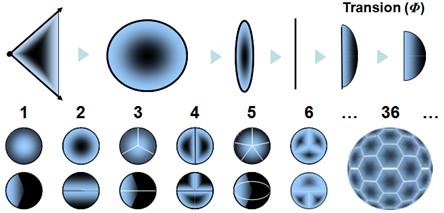
The upper part of the image shows how the axis diagram is replaced by a spherical representation, more convenient for subsequent illustrations. These views depict the same passage point in different forms.
Numbers in the lower part indicate how many spations a transion could pass at once. They count cells, not dimensional types. Label 36 is an example on the plate, not a maximum.
In what follows, a transion will often be shown as a small circle at the center of diagrams. This marker indicates where spations would change domain. We can then follow the medium’s motion around it.
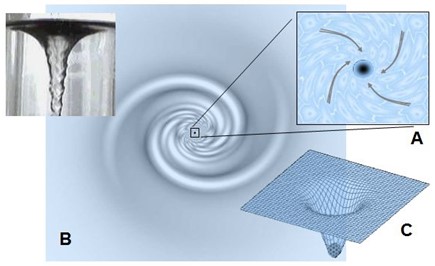
When a transion remains active, passage toward the other domain would leave reduced pressure in the surrounding medium. Neighboring spations would then be pushed toward this region by the medium’s pressure. View B depicts the organization that could form around this center.
In enlargement A, arrows show the proposed motion: spations approach the transion while rotating around it. These two combined motions trace an inward spiral, or vortex.
The photograph provides a classical analogy: a vortex in a liquid helps picture this rotating inflow. In the proposed case, the center corresponds to passage toward another organizational domain.
View C depicts decreasing pressure toward the core. This pressure difference contributes to setting the medium in motion. Flow could continue while passage remains active and the medium sustains this pressure difference.
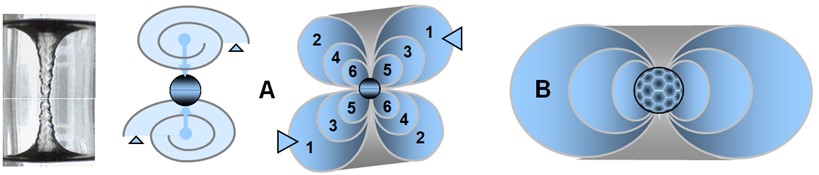
When a transion simultaneously entrains an even number of spations, the flow can organize into two conjugate vortices, shown schematically in B and in cross-section in C. Spations circulate in opposite directions within the two vortices and brace against one another at the central passage, contributing to the mutual stabilization of the flow. The vortex structure can remain stable during this circulation. This configuration could occur for a small even number of simultaneously transferred spations. As this number increases, synchronizing the two flows becomes more difficult: a pressure fluctuation can destabilize the whole and cause it to reorganize into a single vortex, shown in D. In this representation, flow would then favor the single-vortex configuration. In the CdR convention, at rest, two counter-rotating vortices form a magnetic monopole with North–North polarity (C), or South–South if rotational sense is reversed. The single vortex (D) forms a North–South magnetic dipole. The next image returns to the two orientations of this organization to address charge. Spin and then particle generations will be examined later.
Fermions, vortices, geometric chirality and charge
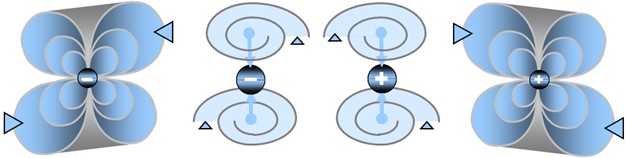
In CdR, fermions—particles with half-integer spin—are envisaged as organizations of the spationic medium whose internal circulation takes the form of vortices. The image shows two organizations, each in two views: outer panels present their polarities, and central panels their flows in section. The two central spiral patterns are mirrors while both converge toward the central passage. The North–North poles of the organization marked − correspond to South–South poles in the one marked +.
These two orientations differ in geometric chirality: the windings of one mirror those of the other.
For the charged configurations shown, CdR associates these opposite windings with a change of charge sign. A particle and its antiparticle would thus correspond to two opposite realizations of the same structure. The image conveys this idea through the − and + signs at the centers of the two vortices.
Spin, internal vortex rotation
In CdR, spin is envisaged as a property of the material organization’s internal motion. The animation proposes picturing two motions: spations circulate through corridors, while the vortex structure itself can remain stable, lead or lag that flow. Flow can thus pass through an organization without the organization moving at the same rate. This distinction offers a way to explore how a particle can carry intrinsic angular momentum while its center remains stationary.
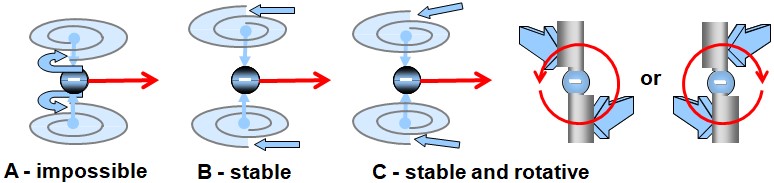
The three configurations compare how arrivals adjust at the central passage while the whole organization moves rightward. In A, the two flows would lack the necessary mutual support: this arrangement is labelled “impossible.” In B, spations arrive from the front and their adjustment would maintain the organization. In C, inclined arrivals would accompany structural rotation: the drawing’s envisaged “stable and rotating” regime.
The two drawings on the right show opposite directions of organizational rotation. In this representation, CdR connects them to the two results of measuring a spin-1/2 fermion along a given axis: “up” or “down.” These states change neither the particle’s charge sign nor its mass; they concern its spin state, distinct from the particle–antiparticle opposition.
Associated Static Wave
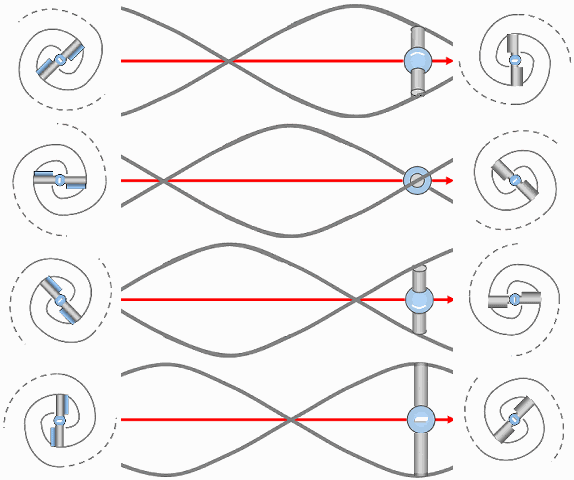
Around the electron, rotation of the two vortices would form an organized imprint in the medium. The animation offers several views: cylinders represent vortices, and gray traces the pattern they would sustain around them. Seen from the side, the pattern crosses into an X; seen along the axis, it winds around the center.
This imprint is called the associated static wave because it would remain linked to the particle during motion. “Static” does not mean everything is motionless: spations circulate, vortices turn and the pattern is renewed while the overall organization accompanies the particle.
Vortices would incorporate spations encountered ahead. Speed here means particle speed relative to the medium it encounters. CdR proposes that their size adjusts to this circulation: more extended at low speed, they would tighten as the particle moves faster. The envisaged tightening concerns vortex size and the extent of their imprint around the particle. Spacing between crossings of the helical trace is a different length, which also depends on rotation rate. This wave would thus give the medium an imprint of the particle’s presence and orientation—a form of memory of spin in motion.
Neutrino, frontal vortex, and neutrality
After the two-vortex configurations envisaged for the electron, a question arises: what organizations would allow transions to transfer an odd number of spations simultaneously? The following image explores three possibilities, corresponding to the transit of 1, 3, or 5 spations at once.

These configurations could support a minimal frontal vortex, moving at a speed close to that of wave propagation in the medium. This organization would exhibit certain features reminiscent of the neutrino: a very small mass, electrical neutrality, and a preferred orientation of spin relative to motion. The vortex’s limited extent could correspond to low configuration energy, offering a possible avenue for understanding its mass.
Under this hypothesis, flow direction would favor one helicity for each internal polarity in the proposed ultrarelativistic regime. The − and + signs in the illustration distinguish these polarities; reversing them would allow two configurations associated with the neutrino and antineutrino to be envisaged. The aim here is to explore a possible correspondence between an organization of the medium and the properties of these particles.
Particle Generations

The three charged-lepton generations—electron, muon and tau—could correspond to different organizations of flow corridors within the same family. The associated transions would allow 2, 4, or 6 spations to pass simultaneously, equally divided between the two vortices. Each vortex would thus have one, two, or three corridors, respectively.
The image compares the first two configurations. The second-generation configuration is larger and has more corridors. The velocity difference between its layers would be smaller, favoring stronger inflareaction. The additional overpressure and density sustained in this way could explain a greater mass.
- First generation — one corridor per vortex: a simple configuration, envisaged as light and durably stable.
- Second generation — two corridors per vortex: a more extended configuration whose flow could sustain greater density and mass, but exhibit lower stability.
- Third generation — three corridors per vortex: an extension of this exploration toward an even more massive organization that is harder to maintain.
This proposal seeks to relate the mass and stability of the generations to the organization of flows and the medium’s response. A more extended organization could thus sustain greater density and energy: CdR seeks the origin of the mass difference in this medium response.
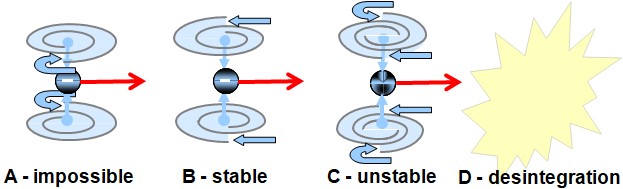
To persist during motion, the vortex must keep receiving the spations feeding its corridors. In configuration B, feeding comes from the front and could remain regular. With several corridors, as in C, some would receive spations less favorably: flows would become unbalanced until the vortex organization broke apart. Figure D illustrates this possible decay.
Corridor count could thus help explain why some organizations persist while others transform rapidly. This possibility links particle stability to continuity of their flows.
Dimensional Flavors
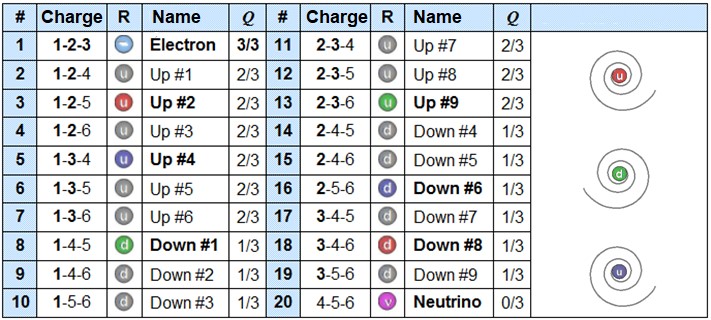
Each particle has a dimensional flavor: the combination of axes in which its vortex is organized. In this representation, the electron belongs to flavor 1-2-3 and the neutrino to flavor 4-5-6. Between these cases, other combinations share one or two axes with the electron’s flavor.
CdR proposes relating shared axes to electric charge. Three shared axes correspond to one unit of charge in magnitude; two or one yield fractions 2/3 and 1/3, associated with quarks. No shared axis gives zero charge, as for the neutrino. This correspondence describes charge magnitude; its sign also requires considering vortex organization.
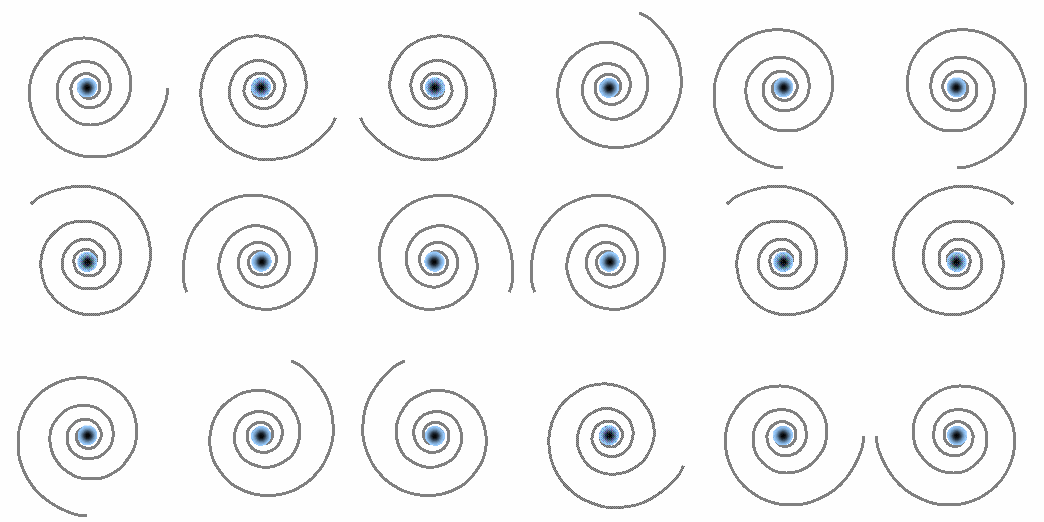
The simplified model shows only eight volumes. The table below unfolds the twenty combinations of three axes among six: one electron-type flavor, nine Up-type, nine Down-type and one neutrino-type. These flavors describe possible medium organizations, rather than twenty isolated particles.Within nucleons, quark variants would alternate to prevent one flavor drawn toward the core from accumulating around them. Their role in interactions will return in the section on fundamental forces.
Further exploration
This popularized presentation is based on the technical documents of the Matter series:
- image030 — Transion Threshold — Structural Limit of Spation
- image031 — Combinatorial Intersection — 6D → 7D Passage
- image032 — Visual grammar of transions — 6D → 7D representations
- image033 — Active transion — hypothesis of an inward vortex
- image034 — Post-transion dynamics — double vortex and tipping toward a single vortex
- image035 — 6D vortex — hypothesis of stable material structure
- image036 — Spin — hypothesis of internal vortex rotation modes
- image037 — Spin — phase difference and double-vortex stability
- image038 — Associated static wave — sustained spatial structure
- image039 — Neutrino — frontal vortex and odd-count transions
- image040 — Particle generations — flow corridors and inflareaction
- image041 — Translating vortex — corridor feeding and instability
- image042 — Dimensional flavors — twenty triplets and relative charges
These documents specify the proposals of the Matter block: transion, vortex, spin, static wave, mass, generations and dimensional flavors.