Anthropology
Further developments and forum discussions
Anthropology studies human beings through their practices, cultures, and ways of life. CdR offers two lines of inquiry. The three senses S1, S2, and S3 offer a way to examine how human beings make sense of experience, organise action, form bonds and develop the explanations and practices they pass on. The relationship between density and complexity invites us to ask how a culture sustains and passes on its practices as they diversify.
The three senses described in Perception provide the following reference points:
- The operative sense (S1) combines intensity or value with principles: understanding by seeking the reason, law or logic that explains.
- The relational sense (S2) combines sensation with relationship: understanding by feeling connections, unity and interdependence.
- The structural sense (S3) combines object or subject with action or transition: understanding by identifying who acts, who possesses, who occupies which position and what changes.
The three senses in group life
I think the three senses have always had a place in human life, fulfilling complementary functions: S3 to activate and establish hierarchies, S2 to bring people together and heighten sensitivity, S1 to explain and ritualise. What changes is how they are expressed, the means available to them and the place given to them by different forms of collective life.
These functions can be carried by one person, shared among several people or organised within institutions. Together, they contribute to how a group responds to what happens to it.
Acting, coming together and seeking the formula
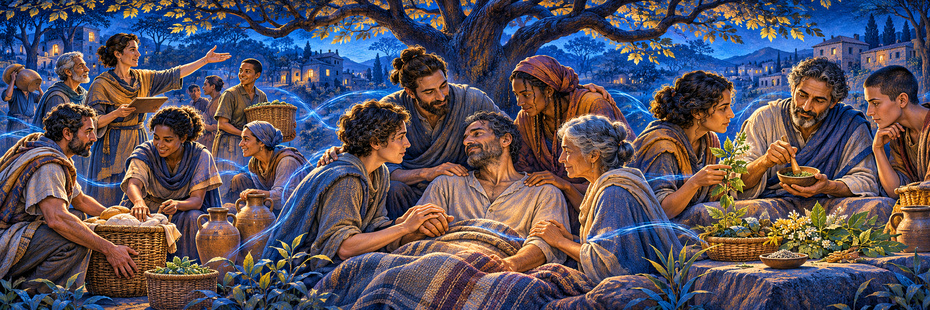
Imagine a community confronted with illness.
S3 activates and establishes hierarchies. It identifies the people and things involved: the ill person, relatives, the healer, remedies and available resources. It considers their condition, capacities, possessions and place in the group. Who is recognised as a healer? Who holds the remedy or the authority to intervene? From these reference points, it initiates and orders action: seeking help, moving the ill person, preparing a place and allocating tasks. It can thus approach the situation through beings and their positions, or through actions and transformations to be accomplished.
S2 brings people together and heightens sensitivity. It makes the sick person’s suffering present to others, elicits support and sustains relationships around them. It can mobilise the family, bring people closer and make the ordeal a shared situation. The manner of accompanying someone then matters as much as the material means involved.
S1 explains and ritualises. By “ritualising”, I mean discovering and asserting the value of a formula considered capable of producing an effect. This formula can combine substances, gestures, words, a sequence of actions or particular conditions.
S1 seeks causes, explores possible procedures and promotes the formulas it considers important. One person can discover, apply, transmit and defend a practice, with different preferences for each activity.
A healer may favour the plants and recipes she knows, then seek other possibilities when the results do not satisfy her. A researcher may devote part of their life to discovery, then more of it to teaching. Functions circulate among people and can change their place over the course of a life.
Healing, obtaining favour from heaven or turning lead into gold can thus belong to the same search for the “magic” formula: the one that would give a hold on a desired transformation.
A formula’s effectiveness and the confidence placed in it are nevertheless distinct. A practice may be retained because it works, because success is attributed to it or because it has become essential to the group’s understanding of its situation.
From functions to recognised roles
When someone succeeds in organising action, bringing others together or proposing a convincing formula, they can acquire a particular place. People return to them when a similar situation arises. Their intervention becomes expected, and their role may stabilise.
I see this as one way the three senses contribute to the formation of social roles. One person is followed for their ability to act and organise resources; another is sought out for their sensitivity and ability to unite; another is listened to for the explanations and procedures they propose.
These forms of recognition can support one another. Someone who explains can give others a reason to follow someone who leads. Someone who brings people together can make a practice shared and encourage its transmission. Someone who organises can provide the means needed to apply it. One authority can also combine these functions.
As a group changes, these functions can acquire more lasting supports: learning, narratives, rules, offices, meeting places or institutions. Their continuity then depends on what people know how to do, but also on how they pass their possibilities on to those who follow.
Preserving a form or serving the context
Each function can also sustain its own preservation.
A formula can retain its prestige despite repeated failures. A hierarchy can defend its positions when collective action would require a different distribution. A sense of belonging can strengthen mutual support among members while reducing their sensitivity towards those outside the group.
Here I return to the distinction between preserving an organisation and improving context. The three senses can serve either. Their presence alone does not guarantee the soundness of a decision or the quality of what a group builds.
In this reading, human evolution concerns in particular the ways these functions combine, are transmitted and are corrected. Techniques, knowledge and institutions transform their means of expression. The questions remain: how to act, with whom to act together, and through what understanding of what matters and what might work?
The three senses in rites and myths
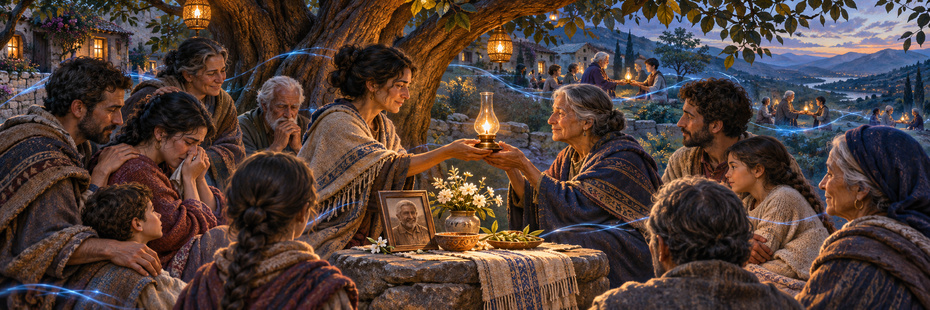
Passing a lamp during a mourning ceremony can honour the memory of the deceased, express support for those close to them, and mark a transition from one role to another.
In this gesture, S1 addresses the value placed on passing on the lamp and the principle that justifies it. S2 involves what participants experience, support for those close to the deceased and the bonds sustained by the ceremony. S3 distinguishes who gives the lamp, who receives it and what this passage changes in their roles or status.
The three senses can come together in the same gesture, and participants may give them different weight. The same framework can help compare versions of a myth by examining the principles at stake, the relationships that change, and the shifts in role or state that mark its stages.
Density, complexity, and cultural transmission
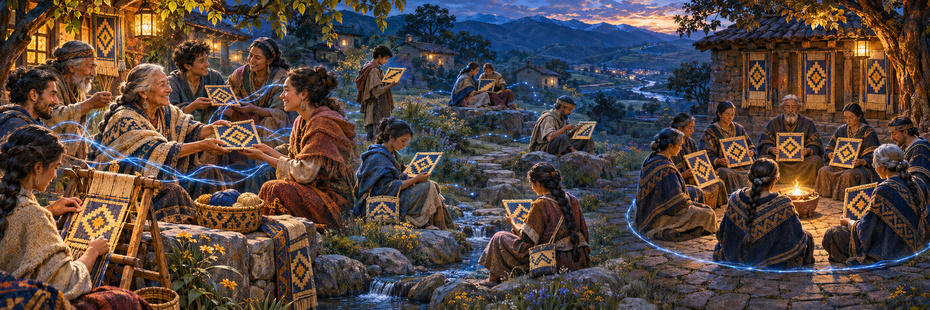
A culture endures because people take up, teach, and adapt its practices. CdR examines this continuity in two ways. Density here refers to the capacity of relationships and institutions to circulate knowledge and sustain it over time. Complexity concerns the diversity of practices, roles, and forms of organisation that must be coordinated.
When practices diversify faster than the means of transmitting and coordinating them, some groups may continue to develop separately. This is one possible route to fragmentation. Conversely, when the rules of transmission become rigid, a practice may persist while losing its capacity to adapt. This is one possible route to stagnation.
To examine this hypothesis, we can follow a practice across generations and observe who passes it on, what varies, and which connections endure. Sociology extends this question to institutions and groups.
Further exploration
To examine the three senses in collective life, their application to rites and myths, and the hypothesis about cultural transmission:
- image201 — The three senses in group life
- image202 — The three senses in rites and myths
- image203 — Density, complexity, and cultural transmission
Note 201 examines the collective functions of the three senses, both approaches of the structural sense and changing roles. Note 202 applies the framework to rites and myths. Note 203 separately examines the density–complexity analogy in cultural transmission. These notes distinguish the author’s proposals, their limits and the conditions for testing them.