Forces & Interactions
Further developments and forum discussions
Gravitation
General relativity describes gravitation as a change in spacetime geometry caused by matter and energy. This geometry determines body and light trajectories as well as the rate of clocks. CdR seeks the medium organization that could produce this response.
In this representation, matter would maintain a local density and pressure deficit by transferring spations through its transions. The surrounding medium would tend to fill it. Gravitation would thus be linked to substrate reorganization around material structures.

In A, the grid illustrates this medium modification: the planet follows an orbit and light bends near the star. The depression visualizes an organization of space and time; it does not represent a material surface supporting bodies.
This reorganization would also affect matter’s internal mechanisms: where medium pressure decreases, clocks would run more slowly. On cosmic scales, the encompassing domain could also deform our spacetime. These extensions will return in the Cosmology chapter.
In B, the funnel evokes a black hole. CdR envisages transfer involving all spation flavors; matter reaching this region would lose its particle organization and contribute to transfer. This intuition must still connect to the relativistic horizon, the boundary beyond which signals cannot return outward. It does not alone settle matter’s fate.
Origin of Quantum Forces
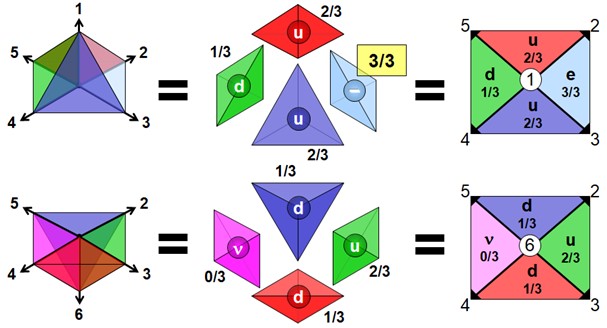
The plate revisits dimensional flavors according to the axes they share with the electron. The electron occupies axes 1, 2 and 3: all three appear in the blue configuration on the right of the upper row, two in the Up configurations, one in the Down configurations and none in the neutrino configuration. The indicated fractions make this overlap visible.
In this representation, directly entraining the electron’s flow would require a grip on all three axes. A current sharing only some of them would not, alone, provide this complete entrainment. Several particles could nevertheless combine their grips: a proton’s three quarks could thus, in some assemblies, together cover the electron’s axes. CdR seeks the origin of electric charge and its action on other particles in this combination of couplings.
Strong Force
Particles sharing dimensional axes could couple their organizations. Their flows would then jostle one another and renew the inflareaction cycles described earlier. The energy of this common organization would contribute to the composite’s mass.
The illustration takes the proton as an example: two Up quarks and one Down quark together carry charge +1. On the left they are represented separately; on the right they form one particle, then give way to the proton symbol.
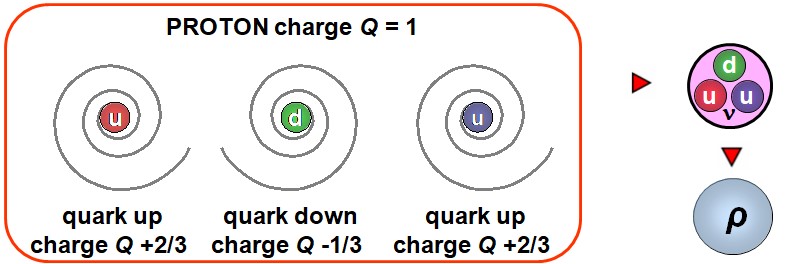
Separating the quarks would deform this common organization and require more energy. CdR seeks in this resistance to separation an origin for the strong cohesion holding them within the proton. At the next scale, it must also explain how protons and neutrons bind together to form atomic nuclei:
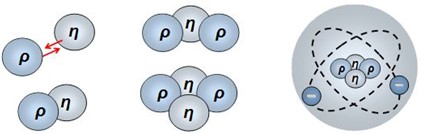
The image shows a proton bound to a neutron, then nuclei grouping two protons with one or two neutrons. These compositions correspond to deuterium, helium-3 and helium-4 nuclei. CdR envisages that proton and neutron organizations complement one another, allowing the medium to maintain their binding.
On the right, two electrons surround the helium-4 nucleus: their negative charges balance those of the two protons. The nucleus thus gives way to an atom, with a new organization around it.
Quark Alternation
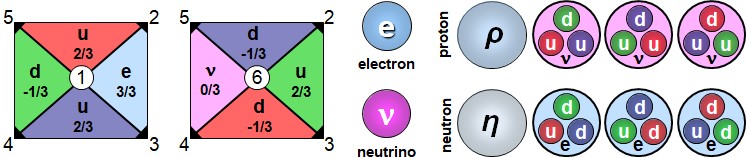
The three drawings in each row show quarks changing dimensional variants. The proton retains its two Up and one Down; the neutron retains its two Down and one Up. Colours, used here as dimensional markers, change, but each remains the same nucleon.

Quark flows would entrain spations of the flavors they couple to towards the nucleon’s core. By changing variants, they would not continually draw on the same flavors: alternation would prevent one accumulating continually around the nucleon and contribute to flow balance. The animation revisits this renewal without turning a proton into a neutron.
Weak Force
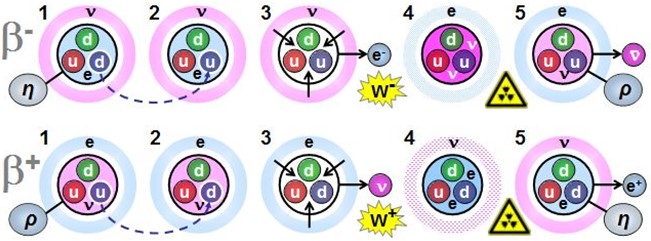
The upper row starts with a neutron: a Down quark becomes Up, giving the nucleon proton composition. In CdR’s representation, this change would also reorganize its surrounding flavor layers. The sequence depicts electron expulsion, incoming neutrino-flavor spations towards the core and subsequent surplus evacuation. The beta-minus decay balance includes an electron and an antineutrino.
The lower row presents the complementary change: an Up becomes Down, giving the proton neutron composition. Reorganization is drawn with neutrino emission followed by a positron. This beta-plus decay can occur in some nuclei whose energy balance allows it; it is not possible for a free proton at rest.
The W-labelled stages and instability pictogram depict the passage between the two organizations. CdR thus seeks to connect a quark’s conversion, the medium response and the appearance of emitted particles.
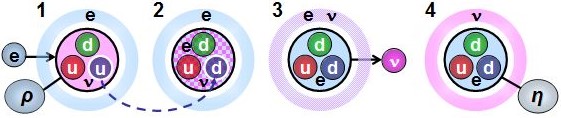
The image depicts an electron reaching a proton’s inner region. In the CdR intuition, its arrival would increase electron-flavor pressure and trigger reorganization: an Up quark would become Down, giving the nucleon neutron composition. The medium response would accompany neutrino emission.
The electron participates in this transformation: it is captured, and the balance connects incoming proton and electron to outgoing neutron and neutrino. Capture requires the system’s energy to allow it. Within an atom, it may involve an electron already bound to the nucleus; the drawing represents it here as entry.
Electrostatic Force
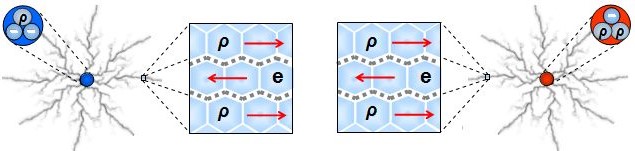
On the left, the blue pole contains more electrons than protons; on the right, the red pole has the opposite excess. In the CdR representation, these particles would draw on the medium components to which they are linked. An electron excess would thus sustain a local electron-flavor deficit, while a proton excess would sustain a local protonic-component deficit.
The insets show how the medium would respond: the electron component would move toward the negative pole, the protonic component toward the positive pole. In each case, the other component would reorganize in the opposite direction. These are movements of the medium, not of free electrons and protons.
This reorganization would orient spations. Extending from neighbour to neighbour, their alignments would produce force lines spreading around each pole. The image’s branching structures depict this alignment network through which the medium would transmit its action to charged particles.
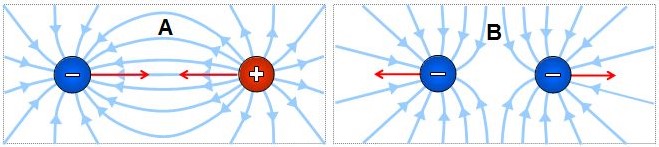
Blue lines represent force lines produced by spation alignments around charges. In the CdR representation, these alignments would transmit the stresses of the medium’s organization to the poles.
On the left (A), charges are opposite. Imbalances are complementary: alignments established around one pole can extend into those around the other. This common organization would favour their approach, indicated by red arrows.
On the right, both charges are negative. They would draw on the same medium component, each tending to orient it toward itself. Between the poles, these orientations would oppose one another; alignments turn away from the central region and the medium response would favour separation. Attraction and repulsion would thus share an origin: how spation alignments connect or oppose one another.
Vector interactions: continuous and discontinuous regimes
Here, “strong” and “weak” name the interaction regimes proposed for continuous and discontinuous flows; they do not directly designate the strong and weak interactions of standard physics.
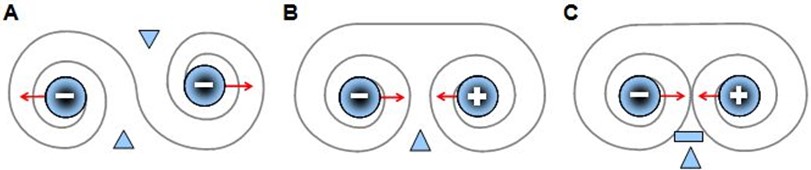
As two vortices approach, spations in their continuous flows would interact. Layer sliding and adjustment of arrivals would change stresses exerted on both organizations.
In A, vortices have the same polarity: their flows would oppose and repel them. Synchronization could nevertheless allow binding while preserving two centres. In B, opposite orientations would allow flows to extend into one another and favour approach.
Approach would also change what feeds each vortex. If each reorganizes the flow maintaining the other, their structures might no longer persist separately. C represents this locking: traces narrow between centres and the blue rectangle marks the envisaged residual region. CdR seeks in this loss of internal organizations and medium reorganization a route toward the propagating forms studied later.
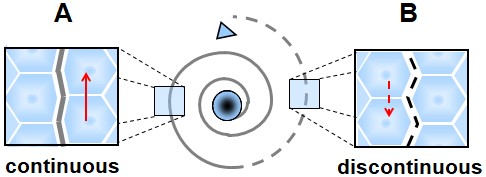
Near the vortex core, layers of spations would entrain one another without interruption: this is the continuous sliding shown in inset A of this figure. Farther away, entrainment could no longer be sustained. The cells’ polyhedral shape would make them resist sliding: their faces and edges would not pass freely over one another. Moving would require deformation or rearrangement of their contacts. Near the core, entrainment would sustain these adjustments; farther away, layers would briefly resist, then yield once stress became sufficient, before being loaded again. Motion would then be transmitted through repeated slips, like a sled pulled by an elastic cord that stretches and releases. The dashed traces in B represent this discontinuous regime.
In this representation, the particle corresponds to the domain where the vortex organization maintains continuous flow. Its external field would extend its influence into layers entrained intermittently. The boundary between them would therefore be a change in the medium’s behaviour rather than a wall around the particle.
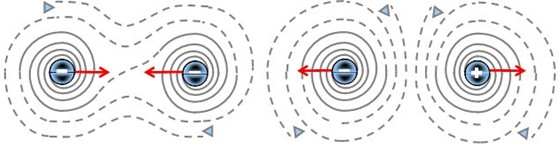
Beyond the region where sliding remains continuous, layers of spations would be entrained intermittently. Between movements, their contacts and alignments could rearrange. Two vortices would thus interact through stresses transmitted in the intervening medium, without their internal regions touching.
In A, like orientations would allow alignments to connect: their shared stress would tend to draw the centres together. In B, opposite orientations would frustrate that connection and tend to push them apart. CdR seeks a physical origin of magnetic interaction in this response of the medium. Signs mark the polarities compared here, − counterclockwise and + clockwise for the same viewpoint. Magnetic force direction also depends on charge arrangement and motion; the connection will be clarified with the next figure.
Magnetic Force
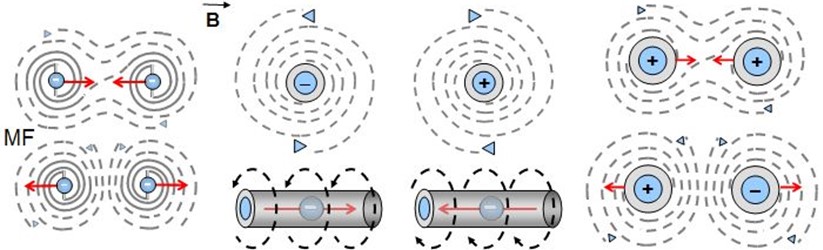
Electron displacement would be accompanied by the barrel motion described earlier. By loading spations around its path, this moving organization would generate a secondary field. In a conductor, contributions from many moving electrons would form a shared organization around the wire, represented by the loops at the centre.
Views above the conductors show the two orientations: + here marks electrons approaching the observer, − those moving away. All retain negative electric charge. Side diagrams represent connection or conflict of field organizations. For two conductors carrying electrons in the same direction, connection would tend to reduce pressure between wires and draw them together. Opposite motion would frustrate this organization and tend to push them apart. CdR thus seeks to explain forces between currents through medium stresses; their resultant depends on the complete configuration.
Electromagnetic Waves
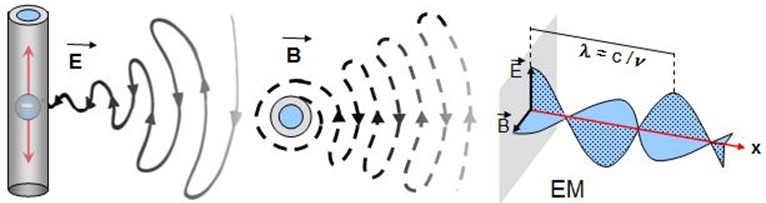
On the left, opposite arrows represent an electron driven in both directions along the conductor. Its motion would change the orientation of surrounding spations. This loading of the medium, associated with electric field E, would accompany a rotational organization, associated with magnetic field B and represented at the centre.
CdR proposes that these responses are transmitted together to neighbouring regions. The disturbance could thus leave its source without the electron accompanying it: this is the electromagnetic wave drawn on the right. The two blue profiles represent its electric and magnetic components, perpendicular to each other and to propagation. Changes in medium organization advance, not two ribbons of substance. Wavelength is the distance travelled by the disturbance during one period.
Wave and Orbit
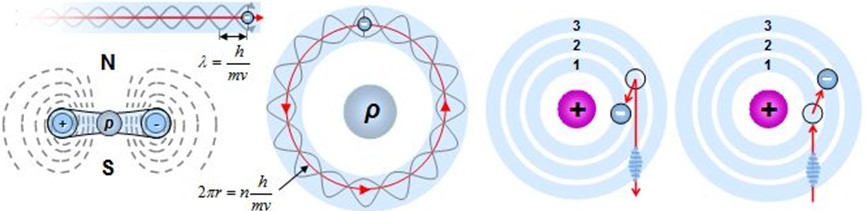
The moving electron would disturb the medium and maintain the associated wave described earlier. This disturbance would act back on the electron. When bound to a nucleus, some configurations could persist because the electron remains in phase with its own wave; mismatch would destabilize others. Energy levels would correspond to configurations where this agreement can persist.
On the left, the illustration associates a wave with electron motion. At the centre, it represents phase agreement by a wave closing on a circle: an integer number of wavelengths fits the path. This closure gives an initial picture of the proposed mechanism before orbital spatial forms are considered.
On the right, rings mark different energy levels. Moving to a lower level can release the difference as a photon; moving to a higher level requires energy input, represented here by an absorbed photon. CdR seeks to describe these exchanges as reorganizations of the electron and its surrounding medium.
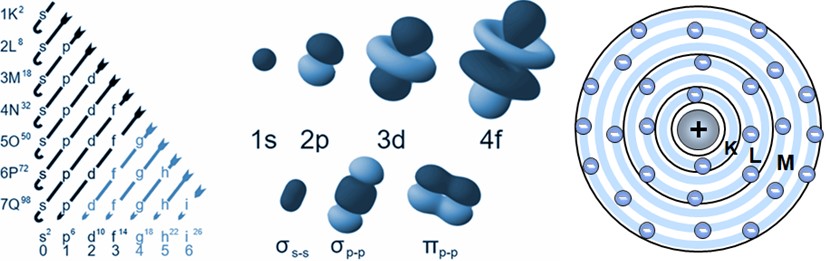
The preceding circle now gives way to spatial forms. Agreement between electron and associated wave would no longer be represented by a simple closed path but by a nucleus-bound organization extending in three dimensions. CdR seeks in orbitals the possible spatial forms of this organization, where the electron and medium response could remain in phase.
On the left, the table connects each letter s, p, d, f, g, h, i to orbital count and maximum electron count. A shell of principal number n can hold up to electrons. These are maxima, not real atomic filling order: each spatial orbital holds at most two electrons with opposite spin projections (Pauli exclusion principle). At the centre, volumes illustrate some orbital shapes; their two shades mark opposite amplitude signs.
As atoms approach, their modes can combine. On the right, and drawings show overlaps along or on either side of the internuclear axis. In the CdR intuition, shared medium organization could contribute to bonding, provided it lowers the energy of the whole system.
The Photon
In CdR, the photon would be a closed vortex: spations engaged in circulation would not simply stop; their motion would close on itself and detach from the organization bound to the source.

The first panel shows the electron and its surrounding disturbances; the second depicts its transition from level 2 to level 1. Subsequent drawings suggest part of this circulation folding and closing. The final view combines the vortex’s rotation with its motion.
Rotation would orient boundary spations along the vortex circumference. Their geometry would then allow the boundary to slide against the surrounding medium without friction: the vortex would thereby decouple from that medium and retain its rotation as long as no interaction removes energy. This freedom to slide would not prevent the photon from displacing the medium along its path.
Inflareaction would sustain its propagation at the limiting speed of waves in spacetime, through the mechanism presented in the next figure. Circulation and propagation would be two aspects of the same organization: a free photon would not pass through a rest state before being launched. By displacing the medium, it would also generate a wave; this wave would allow it to be polarized. The photon’s energy would include that of this accompanying wave. It could be deflected or, if its rotation rate is compatible with that of an open vortex, be absorbed and transfer energy to it. These interactions will be described later.
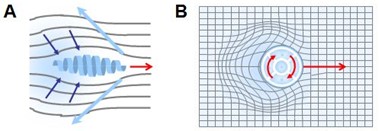
The closed vortex would displace the medium along its path. Displaced spations would relax, while pressure transmitted through other faces of their dimensional organization would replenish the vacated region. This replenishment is the inflareaction described earlier. In this intuition, the medium returning behind the photon would provide the push sustaining propagation.
In A, the blue helix is oriented along propagation. Small dark-blue arrows represent returning medium; large light-blue arrows represent displaced medium. In B, the grid deforms around the vortex and curved arrows depict clockwise circulation. This second panel is a simplified planar schematic: it does not depict another rotation axis transverse to A’s. The two views illustrate the same interaction with the medium without depicting a curved trajectory here.
Speed would be set by how this response passes between spations. Circulation and propagation would form a single regime: a free photon would not be a vortex initially at rest and subsequently launched. The medium’s return would have to transport its organization and accompanying wave without continuously adding energy to the photon. In this conservative regime, energy temporarily exchanged with the medium would be returned through its reorganization: the net balance of free propagation would have to remain zero. If the response changes in matter or a gravitational region, CdR also seeks the origin of light guidance there.
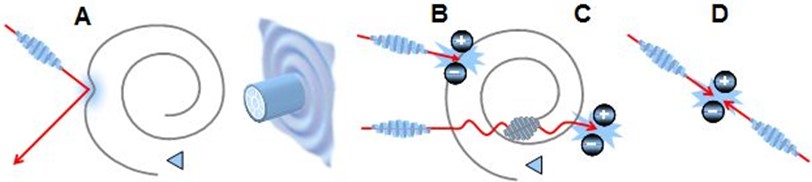
The photon would encounter the medium organization around an open vortex. In A, the encounter deflects its path without absorption. In B, compatible rotation would instead permit capture: the photon would be absorbed and transfer energy to the encountered organization. A mismatch would not necessarily mean reflection; the photon could also continue propagating or be scattered.
Drawings C and D envisage another reorganization: C near the outer boundary of the layered organization, D through its interior. On encountering this organization and its inflareaction regions, the closed vortex could lose its form and open into two material vortices of opposite electric charges: a particle and its antiparticle. The target and medium would participate in the exchange; their energy and recoil must allow pair creation.
In E, two photons meet and could jointly supply the energy and momentum needed for this reorganization. This is not simply cancellation of phases: each photon’s energy and their meeting angle determine whether the channel is possible. CdR seeks the physical mechanism of these transfers in spation dynamics, while balances set their conditions.
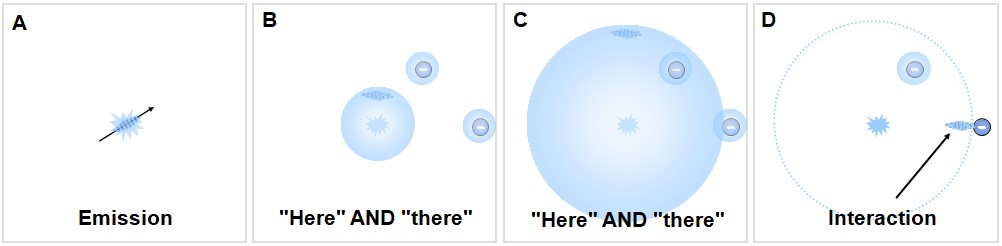
CdR envisages quantum superposition as possibly arising from the spatial and temporal character of fundamental dimensions. This intuition does not yet specify a mechanism connecting those dimensions to observed states; other explanations remain possible.
The schematic explores extended medium preparation, possibly associated with the photon and its accompanying wave. Several electronic organizations could then offer possible interactions with the same excitation. This route remains to be examined; it does not follow from the dimensional intuition alone. “Here AND there” denotes these connected possibilities without multiplying the photon.
In A, the schematic depicts emission. Blue regions in B and C suggest increasingly extended preparation around several sites. In D, the black arrow identifies a particular encounter at the boundary; the dotted circle suggests the boundary of preparation that previously existed. The drawing fixes neither its expansion speed nor its recovery speed.
Complete absorption would destroy the photon at one site and transfer energy to the absorbing system, with necessary recoil and exchanges. It would not leave an identical second photon to absorb elsewhere. Rotation compatibility, polarization, relative phases and overlap with sites would together have to determine possibilities and probabilities; mismatch would not automatically imply reflection.
For this medium-preparation route, how an outcome occurs and how other sites return to their reference state remain to be explained. If preparation physically changes the medium, that change and its recovery require an energy balance and dynamics. Unique absorption alone does not establish instantaneous reset throughout the region.
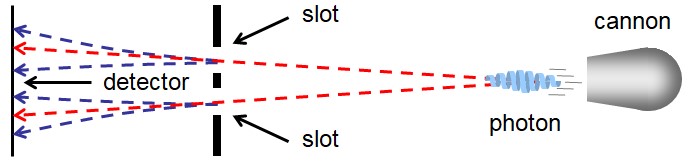
The source on the right sends photons towards two slits; the detector on the left is the screen recording impacts. Dashed traces depict possible contributions at different screen positions. Red and blue distinguish two trace families without specified physical meaning. Their crossings form a geometric fan here; they do not by themselves depict interference. They do not show a measured trajectory for each photon. A one-photon excitation can give local impacts while retaining coherent contributions associated with both openings: it is not replaced by two complete copies. When these contributions remain coherent and indistinguishable, their amplitudes are added before calculating detection probabilities.
CdR envisages superposition as possibly arising from the spatial and temporal character of fundamental dimensions. The schematic does not yet specify how this property would produce amplitudes and phases. Extended preparation of the medium by photon and wave is a route to examine among other possible explanations.
If an apparatus correlates each path with a distinct state, this physical information can reduce screen interference even if nobody reads the apparatus. Partial marking can leave partial visibility. A fixed phase shift, by contrast, can move fringes without erasing them. The depicted detector is not a path marker: studying that case requires adding and defining the interaction.
The physical explanation sought must recover impact distributions, apparatus correlations and photon, wave and medium balances. A local impact alone determines neither a unique prior trajectory nor how an individual outcome occurs.
Further exploration
This popularized presentation is based on the technical documents of the Forces & Interactions series:
- image043 — Gravitation — medium depression and relativistic requirements
- image044 — Electric charges — axis overlap and collective coupling
- image045 — Proton — uud composition, mass and strong cohesion
- image046 — Simple nuclei — proton-neutron complementarity and binding conditions
- image047 — Internal structure of nucleons — quark alternation, flavor variants, and 6D coherence
- image048 — Proton and neutron — animated alternation at conserved composition
- image049 — Beta decay — flavor rebalancing and physical constraints
- image050 — Electron capture — flavor overload and proton–neutron balance
- image051 — Charge and medium polarization — spation alignments and branching structures
- image052 — Electrostatic attraction and repulsion — closure or conflict of force lines
- image053 — Strong vector interactions — vortices under continuous flow
- image054 — Continuous / Discontinuous Boundary — Particle and External Field
- image055 — Weak vector interactions — discontinuous field and inverted polarities
- image056 — Secondary field of the electronic barrel motion — basis of magnetism
- image057 — E/B coupling — minimal conditions of the electromagnetic regime
- image058 — Orbitals — phase condition, quantized action, and bound modes
- image059 — Electronic orbitals — stationary modes and quantum numbers
- image060 — Photon — propagative structure, quantization, and the fine-structure constant α
- image061 — Photon propagation — inflareaction, speed c, and guidance by the Φ flow
- image062 — Absorption and scattering of light — photon–electron capture and selection rules
- image064 — Photon coherence range — extended preparation and unique local selection
- image065 — Single photon, double slit, and path information in CdR
These documents set out the internal mechanisms of the CdR model: gravitation, origin of charges, nuclear interactions, weak force, electrostatics, magnetism, orbitals, and the photon.